ERC-7540 Asynchronous Tokenized Vault Standard
Introduction
ERC-7540 extends the ERC-4626 Tokenized Vault Standard by adding support for asynchronous deposit and redemption flows. It introduces a request-then-claim pattern: users first submit a request (locking their assets or shares), then claim the result after the vault has processed it.
This is needed when a vault cannot settle instantly in one transaction, for example:
- Real-world asset (RWA) protocols like tokenized treasuries, private credit, and other assets with T+1 or T+2 settlement cycles
- Undercollateralized lending where credit assessments happen off-chain
- Cross-chain vault strategies where bridging introduces delays
- Liquid staking tokens with unbonding periods
Vaults can choose to be asynchronous on deposits only, redemptions only, or both. This flexibility lets vault developers add async flows only where the underlying strategy requires it, while keeping the other side synchronous.
Prerequisites
To better understand this page, we recommend you first read about token standards, ERC-20, and ERC-4626.
ERC-4626 vs ERC-7540
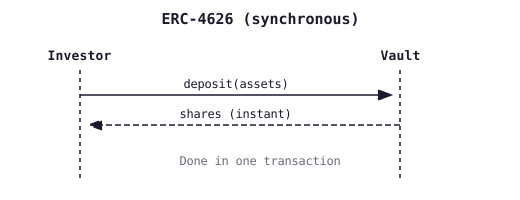
In ERC-4626, a deposit settles atomically: the investor sends assets and receives shares back in a single transaction.
ERC-7540 splits this into two steps. The investor first calls requestDeposit() to lock assets, then waits for the vault manager to process the request. Once fulfilled, the investor calls deposit() to claim their shares. Exchange rates are determined at fulfillment time, not request time.
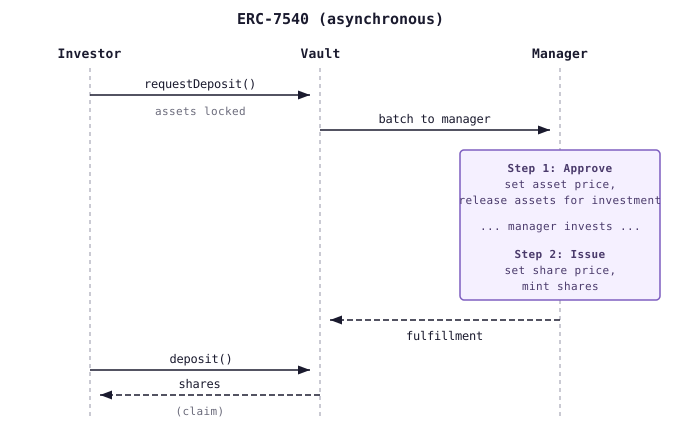
The redemption flow works the same way: requestRedeem() locks shares, and once fulfilled the investor calls redeem() to claim assets.
ERC-7540 Functions and Features
ERC-7540 inherits the full ERC-4626 interface but repurposes deposit/mint/withdraw/redeem as claim functions. The new requestDeposit and requestRedeem functions handle the initial request step.
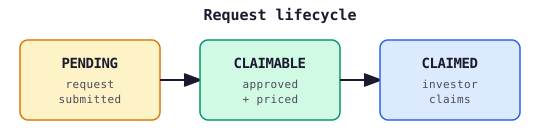
Each request moves through three states: pending (submitted, waiting for processing), claimable (fulfilled and priced), and claimed (investor has collected their shares or assets).
Deposit request flow
requestDeposit
function requestDeposit(uint256 assets, address controller, address owner) external returns (uint256 requestId)
Transfers assets from owner into the vault and submits a request to deposit. The controller address receives control of the request. Returns a requestId identifying the request batch.
pendingDepositRequest
function pendingDepositRequest(uint256 requestId, address controller) external view returns (uint256 assets)
Returns the amount of assets in a pending (not yet claimable) deposit request for the given controller and requestId.
claimableDepositRequest
function claimableDepositRequest(uint256 requestId, address controller) external view returns (uint256 assets)
Returns the amount of assets in a claimable (fulfilled but not yet claimed) deposit request for the given controller and requestId.
Claiming deposits
Once a deposit request becomes claimable, the user calls the standard ERC-4626 deposit or mint function to claim their shares. In ERC-7540, these functions no longer transfer assets (that already happened at request time). They only mint shares to the receiver.
Redemption request flow
requestRedeem
function requestRedeem(uint256 shares, address controller, address owner) external returns (uint256 requestId)
Locks shares from owner and submits a request to redeem. The controller address receives control of the request.
pendingRedeemRequest
function pendingRedeemRequest(uint256 requestId, address controller) external view returns (uint256 shares)
Returns the amount of shares in a pending redemption request for the given controller and requestId.
claimableRedeemRequest
function claimableRedeemRequest(uint256 requestId, address controller) external view returns (uint256 shares)
Returns the amount of shares in a claimable redemption request for the given controller and requestId.
Claiming redemptions
Once a redemption request becomes claimable, the user calls the standard ERC-4626 redeem or withdraw function to claim their assets.
Operator management
ERC-7540 includes an operator pattern (from ERC-6909 (opens in a new tab)) that allows third parties to manage requests on behalf of a user.
setOperator
function setOperator(address operator, bool approved) external returns (bool)
Approves or revokes operator to act on behalf of msg.sender for deposit/redeem requests and claims.
isOperator
function isOperator(address controller, address operator) external view returns (bool)
Returns whether operator is approved to act on behalf of controller.
Request IDs
Request IDs differentiate between different batches of requests. All requests sharing the same requestId are fungible: they transition between states together and receive the same exchange rate.
When a vault returns requestId = 0 for all requests, only the controller address differentiates request state. Multiple requests from the same controller are aggregated.
Events
DepositRequest Event
MUST be emitted when a deposit request is submitted via requestDeposit.
event DepositRequest(
    address indexed controller,
    address indexed owner,
    uint256 indexed requestId,
    address sender,
    uint256 assets
)
RedeemRequest Event
MUST be emitted when a redemption request is submitted via requestRedeem.
event RedeemRequest(
    address indexed controller,
    address indexed owner,
    uint256 indexed requestId,
    address sender,
    uint256 shares
)
OperatorSet Event
MUST be emitted when an operator is approved or revoked via setOperator.
event OperatorSet(
    address indexed controller,
    address indexed operator,
    bool approved
)
Preview functions
The preview functions must revert only for the flows that are asynchronous, because the exchange rate is not known until the request is fulfilled. In an async-deposit vault, previewDeposit and previewMint MUST revert, while previewRedeem and previewWithdraw keep working as in ERC-4626 (and vice versa for an async-redeem vault). This is a key behavioral difference from ERC-4626.