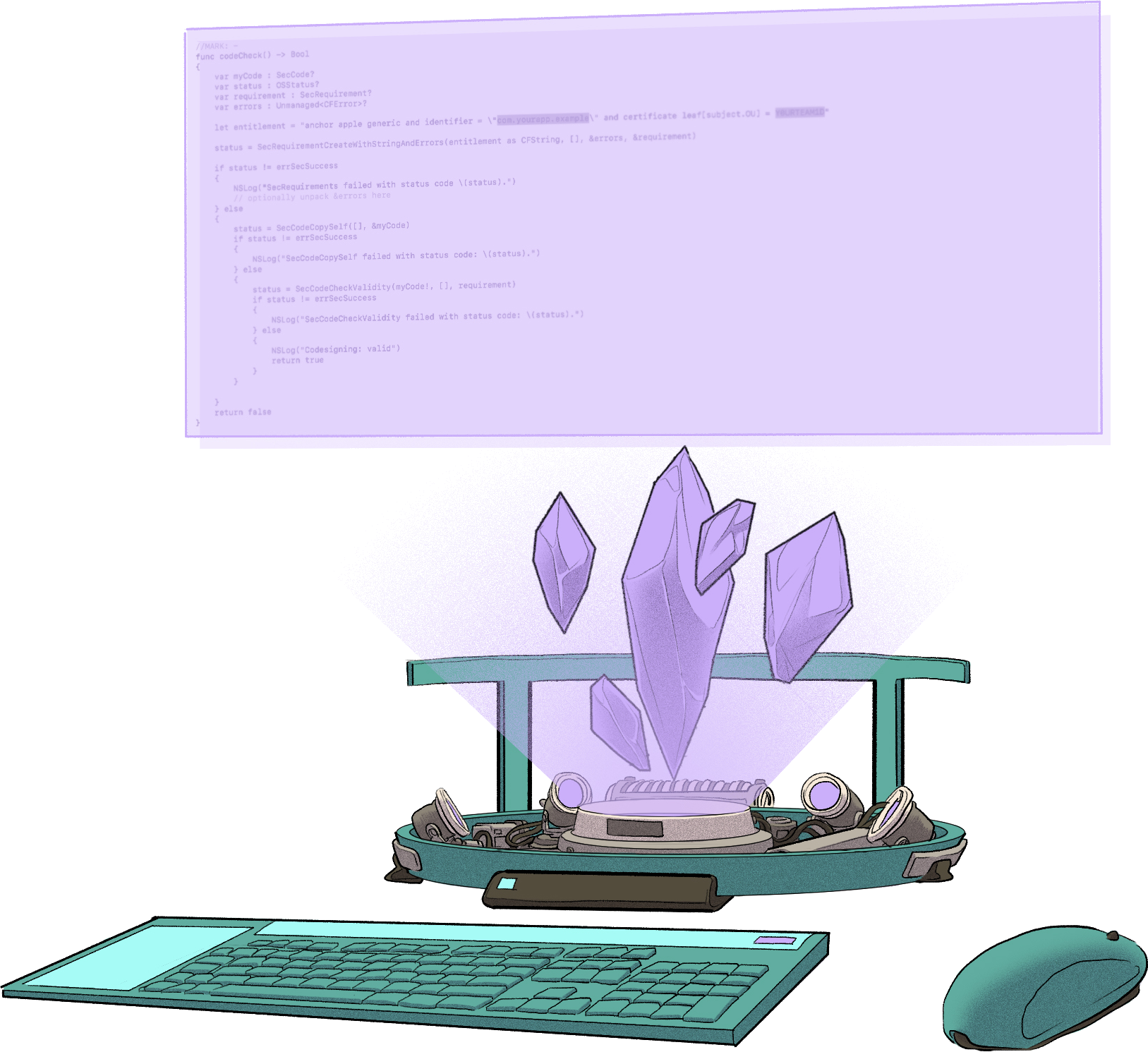
When the things you buy stop being yours
Most of your digital life is operated by a handful of big companies. You may not be able to see how your data is used, why your feed algorithm changes, and have no recourse when a feature you rely on disappears. In exchange, everything is convenient.
This is not hypothetical.
In 2009, Amazon reached into customers' Kindles and remotely deleted books people had bought and paid for.[1] As recently as 2024, Spotify discontinued its Car Thing device and remotely disabled units that customers had purchased.[2]
These cases show the risk of closed software: when a product depends on code and servers controlled by one vendor, that vendor can decide whether the product continues to work.
Open source changes the balance. When the code behind a product is public and its license grants meaningful rights, people can inspect it, run it, repair it, adapt it, and continue it independently. It is the same argument the right-to-repair movement makes about hardware, applied to the software inside it.
What does "free and open source" mean?
Free/libre and open source software (FLOSS, also written FOSS) is software whose source code is public for anyone to run, study, share, and improve. Think of a dish that comes with its full recipe: you can check the ingredients, cook it yourself, pass it on, or make it better. Closed software keeps the recipe and ingredients secret, so one company decides what goes in, who may eat, and whether you ever find out.
You have almost certainly used open source software today without noticing:
- Linux, the base of every Android phone and most of the servers behind the websites you visit.
- Firefox, one of the few major browsers with an independent engine of its own.
- Signal, a messaging app whose encryption protocol also secures every WhatsApp message.
- VLC, the media player that opens the file nothing else will.
- LibreOffice, a full office suite that reads the documents you already have.
"Free" here means freedom, not price. A program can cost money and still be free software; a no-cost app can still be closed and restrictive.
The idea is simple: if a company controls the code, the company controls the user. Free software flips that. It guarantees, legally and permanently, that the software answers to you. In plain language, it grants four freedoms:[3]
Benefits of open source
Free software is a neutral, universally accessible tool for controlling your own digital life. It belongs to no political ideology or movement, and it works the same for everyone who runs it.
Better ways to work together
Open source allows people to learn from one another's work, report bugs, translate text and images, write documentation, improve accessibility, and build tools for individual needs that a commercial roadmap might overlook.
The right to repair
A device usually dies when its software does. Updates stop, the server goes dark, and working hardware becomes waste. The right-to-repair movement fights this in law by requiring that hardware you purchase can be repaired if it breaks; open source is the software half of the same fight. When the code can be read and rebuilt by anyone who owns the device, it outlasts its developer's interest in selling you the next version.
The freedom to publish
Publishing code is speech, and it has had to be defended as such. The right to publish encryption software was won in court in the 1990s. The reverse holds too. When one company controls a tool, it decides what can be said, read, or built with it. Software anyone may copy and republish cannot be quietly switched off.
The right to fork
If maintainers take a project in a bad direction, the community can copy the code and continue on their own path. Popular tools like LibreOffice, Jenkins, and OpenTofu all exist because communities exercised this right when corporate owners changed course. Forks are the safeguard against capture.
How to switch to open source apps
You do not need to replace everything at once. Start with one tool you use often, and explore whether any widely-adopted open source alternatives for that tool exist. Different open source alternatives may be optimized for the outcomes that matter most to you, like better privacy, fewer subscriptions, local control, data portability, or the ability to contribute.
Consider tradeoffs honestly before making a full switch. FLOSS and privacy-protecting software sometimes trade convenience for control. Anti-tracking protection may occasionally break heavily scripted websites, untracked search may lack hyper-localized predictions, and maps that refuse to follow you may lack real-time traffic data. You can download and try an open source alternative to see if it meets your needs before fully migrating off of a closed app.
Open source apps

















Open source and AI
AI cuts both ways here. The AI assistants most people use are proprietary services running on someone else's computer. But they are also, right now, one of the best tools available to help you get started with open source software. There are also open AI models you can run yourself that never send information back to a centralized AI provider.
AI prompts to help you get started
The hard part of switching is rarely the software itself: it is knowing what exists, whether it is any good, and what to do when something breaks. An AI assistant closes most of that gap, and it can read a project's code and answer in plain words, so you do not need a developer's skill set to check the one thing that worries you.
Things worth asking. Click any card to copy it, then fill in the blanks:
One AI setting worth changing
Add "always prefer free and open source options, and tell me the license" to your assistant's configuration and it becomes the default for every future conversation. Open alternatives then show up in the AI assistant's answers without you having to ask for them specifically.
Running AI locally on your own computer
Most chat assistants are services. Your prompt leaves your device, the company sets the rules, and access can be changed, priced, or discontinued at any time. It does not have to work that way.
Models with published weights can be downloaded and run on hardware you already own. No account. No API key. No subscription. Nothing sent anywhere, so you can unplug the network and keep working. And once the file is on your disk, it is yours. No one can deprecate your local AI model, silently change it, or take it away. A model you download today will still answer questions on that machine in ten years.
Three ways in:



Open beyond code
Long before Ethereum existed, people were making these arguments and winning them. They wrote the licenses described on this page, won the court cases that made publishing code lawful, and built the tools millions rely on to speak and read unwatched. Privacy, ownership, repair, freedom of speech, the right to read: Ethereum holds the same commitments because it grew out of the same tradition, and the organizations below are where much of that ground is still defended, case by case and tool by tool. Much of what this page describes exists because of them. They are independent of Ethereum and set their own priorities, and all of them are worth supporting.
Organizations defending digital rights
Free Software Foundation
Maintains the free software definition and the GNU project
Electronic Frontier Foundation
Defends digital civil liberties in the courts and in public policy
Open Source Initiative
Stewards the open source definition and the list of approved licenses
Tor Project
Builds open anonymity and anti-censorship tools
Fight for the Future
Campaigns for an open internet and against mass surveillance

Internet Archive
Preserves the web and defends the right to read, lend, and archive online
Also worth knowing:
- The Linux Foundation (opens in a new tab)
- Ludlow Institute (opens in a new tab)
- Mozilla Foundation (opens in a new tab)
- Software Freedom Conservancy (opens in a new tab)
- World Ethical Data Foundation (opens in a new tab)
Open knowledge
Some of the most useful knowledge ever put online is free because the people who built it chose to keep it that way, including peer-reviewed university textbooks, course material from world-class universities, encyclopedias in hundreds of languages, maps of the entire planet, or research that would otherwise sit behind a paywall.
- Open education: OpenStax (opens in a new tab), MIT OpenCourseWare (opens in a new tab).
- Open science: DOAJ (opens in a new tab) for open access journals, arXiv (opens in a new tab) for preprints, and Zenodo (opens in a new tab) for research data and code.
- Commons and peer production: P2P Foundation (opens in a new tab).
- Open culture: Creative Commons (opens in a new tab), the public domain, Wikipedia (opens in a new tab), OpenStreetMap (opens in a new tab).
Why is Ethereum open source?
Ethereum is a public network built through open specifications and independently developed software. No single company owns the protocol or has exclusive control over how people access it. Anyone can inspect the code, review proposed changes, run software that connects to the network, or build applications that use the protocol.
- The network's rules are implemented by multiple independent teams, so no single company controls what it does.
- Anyone can run a node and independently verify the network.
- Researchers and developers discuss protocol changes openly.
- Contributors can improve code, documentation, translations, education, tooling, and community resources.
A different future is possible, one where openness is built in and the things you rely on keep working for you.
Ethereum's openness does not mean every application built on it is open source, safe, or trustworthy. You should still evaluate the software, contracts, teams, and risks involved. But the protocol itself is designed so that its foundations can be inspected and improved in public.
Proprietary, open source, and free software: what's the difference?
"Open" gets used loosely, and the differences matter. Four families cover almost everything you will meet:
Typical licenses: No license to the source at all
Real examples: Windows, iOS, Photoshop
Typical licenses: BUSL 1.1, SSPL, many "open core" licenses. Not OSI-approved (opens in a new tab).
Real examples: Terraform, which moved from the open MPL 2.0 to BUSL 1.1 in August 2023. That change is why the community forked OpenTofu.
Typical licenses: MIT, Apache 2.0, BSD, MPL 2.0
Real examples: Lighthouse, Reth, Besu, Teku (Apache 2.0); Nimbus (Apache 2.0 / MIT); this website (MIT)
Typical licenses: GPL, LGPL, AGPL
Real examples: Linux (GPL-2.0); Ethereum clients: go-ethereum (GPL-3.0 for the binary, LGPL-3.0 for its libraries); Prysm, Nethermind, Grandine, Solidity (GPL-3.0)
Ethereum runs on copyleft, not just on the word "open"
Plenty of projects call themselves open. What matters is the license file, so here is ours.
Ethereum's most critical infrastructure ships under the Free Software Foundation's own copyleft licenses: go-ethereum is GPL-3.0 with LGPL-3.0 libraries, and Prysm, Nethermind, Grandine, and the Solidity compiler are GPL-3.0, with Erigon under LGPL-3.0. Other clients take the permissive route: Lighthouse, Reth, Besu, and Teku are Apache 2.0.
This website is MIT, and every change to this page is publicly visible. Anyone is free to inspect the source code (opens in a new tab) or suggest changes (opens in a new tab).
Client diversity is itself an application of the right to fork. No single implementation controls the network, and any of them can be replaced by something better without asking permission.
Frequently asked questions
"Free software" and "open source" come from related traditions. Free software emphasizes users' rights and freedom. Open source often emphasizes practical benefits such as collaboration, reliability, and better software. In practice, both describe software whose license grants people real rights to use, study, modify, and share it.
This page uses the terms together, as FLOSS, because the distinction rarely changes what you can do with the software in front of you.
It is a fair question, and the answer is not a flat no. Publishing code does let attackers study it. But it lets everyone else study it too, and secrecy has a poor record as a defense: closed software has the same flaws, found later, disclosed on the vendor's schedule, and fixed when it suits them.
The honest version is that openness is necessary but not sufficient. Serious bugs have sat unnoticed in widely used open projects for years, usually because critical infrastructure was being maintained by one or two unpaid people. What openness guarantees is that anyone can look and anyone can fix it; whether enough people do depends on how well the project is funded and staffed. That is worth checking before you depend on something, and it is an easy thing to ask about.
Most AI models described as open publish their weights but not their training data or the code that produced them. You can run and adapt them; you cannot fully study or rebuild them. By the definitions set out on this page, that is closer to source-available than to free software.
It is still a large improvement on the closed alternative. An open-weight model you have downloaded runs without permission, cannot be revoked, keeps working when the company behind it changes direction or disappears, and can be independently tested by anyone who wants to check its behavior. Those are the same benefits, freedom to leave and software that outlives its maker, that the rest of this page is about. The Open Source Initiative's Open Source AI Definition (opens in a new tab) sets out what full openness would require, and a handful of models such as AI2's OLMo and EleutherAI's Pythia already meet it.
Further reading
- Amazon Chief Says Erasing Orwell Books Was "Stupid" (opens in a new tab) - The New York Times (archive)
- Spotify officially kills Car Thing, remaining units no longer work (opens in a new tab) - 9to5Google
- The Free Software Definition (opens in a new tab) - GNU Project
- The Open Source Definition (opens in a new tab) - Open Source Initiative
- Roads and Bridges: The Unseen Labor Behind Our Digital Infrastructure (opens in a new tab) - Nadia Eghbal, Ford Foundation
- Behind the One-Way Mirror: A Deep Dive Into the Technology of Corporate Surveillance (opens in a new tab) - Electronic Frontier Foundation
- Adversarial Interoperability (opens in a new tab) - Cory Doctorow, Electronic Frontier Foundation
Finding alternatives
- Switching.software (opens in a new tab) and Privacy Guides (opens in a new tab): more catalogs of open replacements for everyday software.
- De-Googled ecosystems: GrapheneOS (opens in a new tab), /e/OS (opens in a new tab), LineageOS (opens in a new tab), F-Droid (opens in a new tab); open hardware from Framework (opens in a new tab), Pine64 (opens in a new tab), and MNT Reform (opens in a new tab).